



What does a voice AI agent actually do?

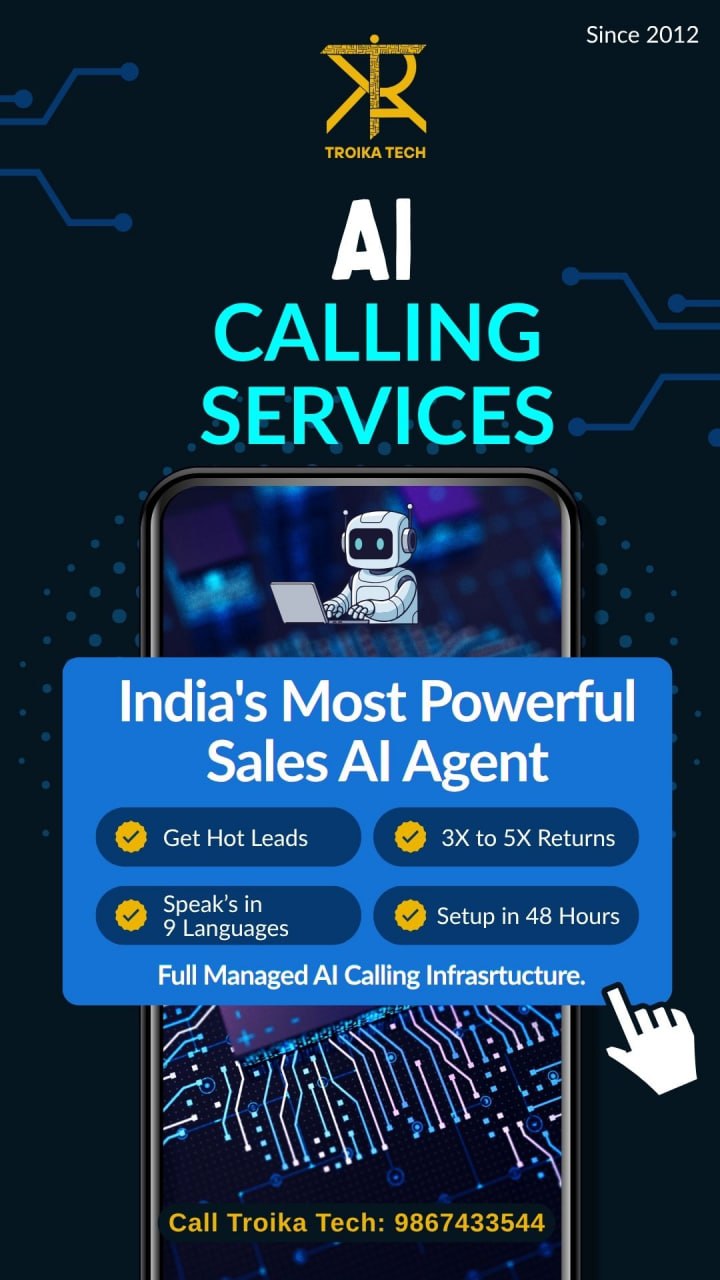
A voice AI agent is software that can conduct spoken conversations with customers, understand their requests and respond according to a business-defined workflow.


Unlike a basic automated menu that only asks callers to press numbers, a modern voice AI agent can understand conversational requests, respond using approved business information, ask follow-up questions and perform selected actions.
Conversation becomes a business workflow
A customer can call, explain what they need, answer qualification questions and receive the next appropriate response without every routine interaction requiring a staff member.
Outbound follow-ups
Contact leads or customers using a structured conversation.
Appointments
Collect requirements and support appointment-related workflows.
From first conversation to going live
Troika Tech begins with the business process rather than the technology. That keeps the voice AI agent focused on the calls that matter most and makes the implementation easier to measure.
Discover
Understand your call volume, customer questions, workflow and automation goals.
Test
Configure the agent and test common, unexpected and business-critical scenarios.
Launch
Go live, monitor performance and refine conversations using real usage patterns.
Designed for practical execution
A voice AI deployment works best when the conversation is connected to what your team actually does after a call.
- ✓Defined qualification questions
- ✓Clear human escalation points
- ✓Structured customer information
- ✓Workflow-based automation
Built around Eluru's local business needs
Eluru businesses serve a broad mix of residents, students, patients, property buyers, traders and customers from surrounding areas. Phone conversations remain important when people want a quick answer before deciding what to do next.
Real Estate & Property
Property teams can qualify buyer and rental enquiries, understand preferred property types and arrange callbacks or site-visit requests.
Healthcare & Diagnostics
Clinics, hospitals and diagnostic centres can manage appointment enquiries, service information and selected follow-up calls.
Retail, Education & Services
Shops, training institutes and service providers can capture enquiries, answer routine questions and follow up with prospective customers.
Where local context makes a difference
Consider a property business receiving enquiries from customers looking for homes or commercial opportunities around areas such as Power Peta and the Eluru Main Road business corridor.
Instead of allowing every enquiry to enter a generic queue, a voice AI agent can begin the conversation, ask whether the customer is looking to buy or rent, understand the preferred property type, capture a useful budget range and determine whether a site visit or human callback is appropriate.
This creates a more useful handoff for the sales team. The employee receives structured information instead of starting every conversation from zero. Customers can also receive an initial response even when the team is busy with another caller or outside its normal working hours.
Qualify the requirement
Ask relevant questions that help separate useful prospects from routine enquiries.
Route the next step
Move suitable conversations toward a callback, appointment or human interaction.
Improve over time
Review real conversations and refine the workflow as customer needs become clearer.
What should businesses measure?
The value of voice AI is not simply the number of calls an automated system can answer. Businesses should connect the implementation to outcomes that affect customer experience, productivity and revenue.
Faster first contact
Give callers and prospects an immediate first response instead of depending entirely on staff availability.
Less repetitive workload
Let employees spend more time on conversations that require judgement, negotiation or personal attention.
More consistent processes
Apply defined qualification and response rules consistently as call volumes or business requirements increase.
| Business need | Voice AI role | Human role |
|---|---|---|
| Routine enquiry | Automate | Escalate when needed |
| Lead qualification | Capture & qualify | Follow up |
| Complex requirement | Gather context | Handle personally |
| Appointment workflow | Support scheduling | Manage exceptions |
Voice AI questions businesses ask
A voice AI agent company develops AI-powered systems that can conduct spoken conversations with customers over the phone. Unlike a basic automated menu that only asks callers to press numbers, a modern voice AI agent can understand conversational requests, respond based on predefined business information, ask follow-up questions and perform selected actions. For example, a business in Eluru could use a voice AI agent to answer a customer asking about a service, collect their name and requirements, identify whether the enquiry is sales-related and pass qualified leads to the appropriate team. Troika Tech develops these systems around specific business objectives rather than treating voice automation as a generic phone-answering tool. The agent can be structured for inbound enquiries, outbound follow-ups, lead qualification, appointment handling, reminders or other repetitive conversations.
Eluru has a diverse local business economy serving residents, students, patients, property buyers, traders and customers from surrounding areas. Many enquiries still begin with a phone call, particularly when customers want quick answers before visiting a business. Voice AI can help businesses respond when employees are unavailable, outside normal working hours or already handling another customer. It can also provide a consistent first response instead of allowing calls to go unanswered. Local language capability can be important. Depending on the audience, businesses may need conversations in Telugu as well as English or Hindi. A properly designed AI calling solution can account for these language preferences and make the interaction more accessible. For an Eluru real estate business, for instance, an AI agent could contact new enquiries, ask whether the customer is looking to buy or rent, understand their preferred property type and arrange a callback or site-visit request for the sales team.
Voice AI is most useful for businesses where telephone conversations are frequent, repetitive or directly connected to revenue and customer service. Real estate companies can automate initial lead qualification and follow-ups. Healthcare providers can manage appointment-related enquiries and reminders. Educational institutions can respond to course enquiries and capture prospective student information. Retailers and local service companies can handle product, availability and service questions. It is also valuable for businesses with small teams. Instead of hiring additional staff simply to handle predictable calls, companies can automate the first stage of conversations and allow employees to focus on customers who need human assistance. The right use case is not about replacing every human conversation. It is about identifying repetitive interactions that can be handled reliably by AI while creating a clear path to a human employee whenever the situation requires it.
The cost of a voice AI solution depends on factors such as call volume, conversation complexity, integrations, languages, outbound calling requirements and the actions the agent needs to perform. A simple enquiry-handling agent has different requirements from a system that connects with a CRM, qualifies leads, schedules appointments and triggers follow-up workflows. The value should therefore be measured against business outcomes rather than the technology alone. Businesses can consider metrics such as calls handled, leads captured, response time, qualified enquiries, appointments booked and staff hours saved. Troika Tech can design the implementation around the actual workflow so businesses do not have to invest in unnecessary features. Starting with a focused use case can also make it easier to measure results before expanding voice automation across additional processes.
Implementation time depends on the complexity of the required voice AI agent. A straightforward enquiry or lead-qualification workflow can be planned and developed faster than a system requiring multiple integrations, complex business rules or several conversation paths. Troika Tech starts by understanding the business process and defining what the agent should handle and when a conversation should move to a human. The next stage involves conversation design, configuration, integration where required, testing and refinement. Before going live, the agent should be tested against common questions, unexpected responses and different customer scenarios. This helps reduce confusing conversations and ensures the AI follows the intended workflow. After deployment, performance can be reviewed using practical indicators such as call completion, lead capture and escalation patterns. The conversation flow can then be improved based on real usage.
Troika Tech focuses on practical implementation rather than adding automation simply because it is technically possible. We start with the business outcome and build the voice workflow around it. Our approach combines custom conversation design, AI automation, business-process understanding, integration capability and ongoing support. This allows the voice agent to reflect how your team actually handles enquiries instead of forcing your business into a rigid template. Troika Tech can also help businesses identify where human involvement remains important. High-value or complex conversations can be escalated to staff, while routine questions and repetitive follow-ups can be automated. For Eluru businesses, that practical approach matters because customer expectations can vary across sectors and language preferences. The goal is a voice AI system that supports your existing team, captures more opportunities and scales as call requirements grow.
Where voice automation is heading
Voice AI adoption is increasingly being evaluated through practical business outcomes. The important question for an Eluru business is not whether AI exists, but whether a particular workflow can be automated reliably and measured properly.
In 2026, many businesses report greater interest in AI-assisted customer communication as teams look to manage enquiries without continuously increasing staffing requirements.
Recent digital adoption trends show conversational AI moving beyond text chat into voice-based customer interactions, particularly for repetitive service and sales workflows.
Industry reports in 2026 indicate businesses are increasingly evaluating AI through response speed, lead handling, productivity and customer experience rather than technology adoption alone.
For local businesses, multilingual digital experiences remain important where customers naturally switch between regional languages, Hindi and English during commercial interactions.
Technology that follows the business objective
Troika Tech builds voice AI around the work your team needs to accomplish, with customization, measurable outcomes and a practical path from automation to human support.
Built around your process
We map the actual customer journey, define the questions the AI should ask and create rules for qualification, escalation and follow-up.
Focused on measurable outcomes
The objective is practical: answer more enquiries, capture useful lead information, reduce repetitive workload and improve response consistency.
Flexible as requirements grow
Start with one focused workflow such as lead qualification or appointment calls, then expand into additional processes and integrations.
Human support remains part of the design
Good automation should not create a wall between customers and employees. Troika Tech can structure escalation points so complex, sensitive or high-value conversations reach the right human team member when necessary.
- ✓Custom conversation design
- ✓Business-process understanding
- ✓Integration capability
- ✓Ongoing refinement and support
Find the calls worth automating first.
A focused voice AI workflow can help an Eluru business respond faster, capture better information and reduce repetitive calling work without removing the human conversations that matter most.
Start with your workflowA practical starting point for Eluru businesses
A well-designed voice AI agent can help Eluru businesses respond faster, manage repetitive calls and turn more customer conversations into useful business opportunities. Troika Tech combines customized AI workflows, practical automation and ongoing support to create voice solutions aligned with your goals. Start by discussing your current call process with Troika Tech and identify where voice AI can deliver the most measurable value.