
Voice automation built around real customer conversations.
Voice AI systems allow businesses to communicate with customers through natural telephone conversations, collect information, answer defined questions, qualify enquiries, and route important interactions to human teams.
Unlike a traditional IVR that mainly asks callers to press numbers, conversational voice AI can understand spoken requests and follow a structured workflow. A Kolkata clinic, for example, could use Voice AI to handle appointment enquiries, collect a preferred time, confirm contact details, and pass the request to the appropriate team.
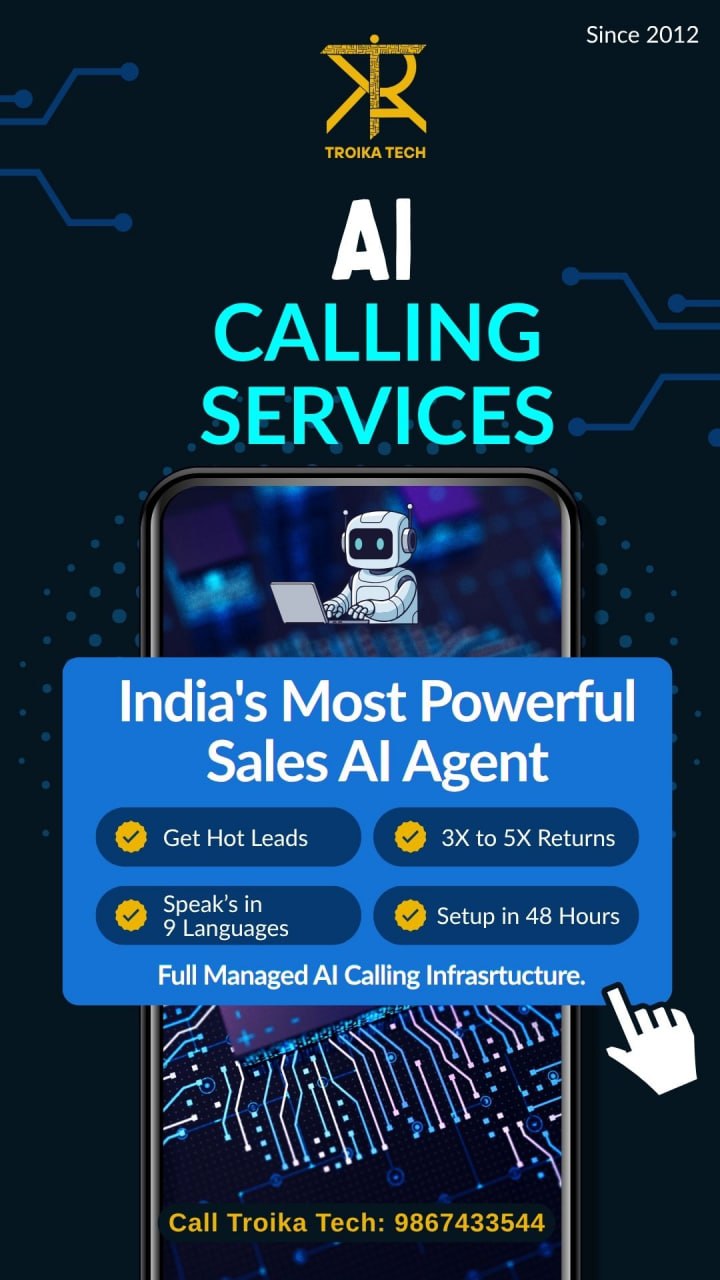
Troika Tech designs the conversation around the business outcome first. That can mean qualified leads, booked appointments, faster support, better follow-up, or less repetitive calling work for employees.
What a Voice AI workflow can handle
The system can be connected to business tools such as CRMs, calendars, databases, lead-management systems, or internal APIs so a conversation can trigger a useful business action.
Answer common customer questions and capture requirements.
Reach prospects or customers according to defined rules.
Pass important or complex conversations to the right team.
From the first call to a production-ready workflow.
Troika Tech starts with your existing calling process and identifies where automation can create measurable value without making the customer journey complicated.
Understand
Map call volume, goals, languages, questions, and systems.
Design
Define conversation paths, qualification, escalation, and actions.
Build
Configure the voice experience and test real customer scenarios.
Launch
Go live, monitor outcomes, and refine the workflow as needed.
Inbound call handling
Answer common enquiries, capture details, and route conversations without forcing every caller through a rigid menu.
Lead qualification
Ask relevant questions about budget, requirements, location, timing, or service needs before a sales team takes over.
Appointment workflows
Support booking requests, reminders, confirmations, and follow-ups where a spoken conversation is more convenient.
Customer support
Handle defined service questions and escalate cases that require a trained human representative.
Designed for Kolkata's multilingual customer base
Kolkata businesses may receive calls in Bengali, Hindi, English, or a natural mix of languages. The conversation design should reflect how customers actually communicate instead of assuming every caller will use formal English.
- Bengali-English conversations
- Natural customer questions
- Defined business rules
- Human escalation paths
- CRM and API connectivity
- Lead and appointment workflows
Built for the way Kolkata businesses actually operate.
The strongest Voice AI opportunities are usually found where teams receive repeated enquiries, spend significant time on follow-ups, or need to respond quickly to a large number of prospects.
Clinics & Diagnostic Centres
Automate appointment enquiries, reminders, follow-ups, basic information requests, and patient routing while allowing staff to focus on cases requiring human attention.
Property Businesses
Qualify enquiries by budget, preferred location, property requirements, and buying timeline, especially for prospects exploring New Town and surrounding growth corridors.
Admissions & Local Services
Handle admission questions, course enquiries, service requests, callback requirements, and promotional follow-ups for customers across Kolkata.
Location matters because a business serving Salt Lake Sector V may have a different customer journey from a hospitality or retail business around Park Street. Troika Tech can shape the voice workflow around the audience, service model, language mix, and operational requirements of the business.
Questions Kolkata businesses ask about Voice AI.
A Voice AI Company develops systems that can communicate with customers through telephone conversations using artificial intelligence. Unlike a traditional IVR that mainly asks callers to press numbers, a modern voice AI system can understand spoken questions, respond conversationally, collect information, follow a defined workflow, and escalate a conversation when human assistance is required. For example, a Kolkata clinic could use Voice AI to answer questions about available appointments, collect a patient's preferred time, confirm contact details, and pass the booking request to the appropriate team. A real estate company could use it to ask about property requirements and identify which enquiries need immediate sales attention.
Kolkata businesses often serve customers with different communication preferences and languages. Bengali is particularly important for local customer interactions, while English and Hindi are also common in professional, retail, education, healthcare, and service conversations. A useful voice system therefore needs to handle the way customers actually speak rather than assuming every caller uses formal English. The local business mix also creates many repetitive phone interactions. A healthcare centre may receive appointment enquiries, a property company may receive repeated requests for project information, and an education business may answer questions about courses, admissions, fees, and schedules.
Voice AI is particularly useful for businesses with high call volumes, repetitive questions, lead follow-ups, appointment workflows, or customers who prefer speaking rather than typing. Typical use cases include healthcare, real estate, education, retail, e-commerce, finance, professional services, logistics, and local services. The strongest opportunity is usually where employees spend significant time repeating the same information or manually following up with large numbers of prospects.
The cost depends on factors such as call volume, conversation complexity, languages, telephony requirements, integrations, outbound versus inbound calling, reporting, and the level of customization required. A simple enquiry workflow will normally require less development than a system connected to multiple business platforms. The right way to evaluate the investment is not only by comparing software costs with employee salaries. Businesses should also consider response speed, missed calls, lead follow-up, staff time, appointment attendance, qualification quality, and the value of conversations that would otherwise be delayed or lost.
The timeline depends on the workflow. A focused voice assistant with a small number of conversation paths can be prepared relatively quickly, while a larger implementation involving CRM integration, multiple languages, complex qualification, analytics, and custom business rules requires more testing. Troika Tech starts by documenting the conversation flow and business requirements. We then configure the voice experience, connect the required systems, test common and unusual customer responses, review escalation conditions, and prepare the production setup.
Troika Tech focuses on practical implementation rather than treating Voice AI as a standalone technology demonstration. We begin with the business outcome and then design the voice workflow around it. Our approach can include multilingual conversation design, lead qualification, appointment workflows, customer support, outbound follow-ups, CRM connectivity, escalation to human teams, and reporting. For a Kolkata business, this also means considering the actual customer journey. A property company serving New Town may need a different qualification flow from a diagnostic centre near Park Street. A local education provider may need Bengali-English admission conversations, while a B2B technology company may need a more formal English workflow.
Voice remains a practical customer channel.
Voice AI is developing alongside existing customer-service and sales channels. The useful question for a business is where voice automation can improve a real workflow rather than whether every interaction should be automated.
In 2026, Indian business-calling research reported that surveyed businesses identified voice as their most adopted customer-engagement channel.
Recent 2026 research found that surveyed Indian consumers preferred receiving voice calls from businesses.
Recent digital adoption trends show growing interest in regional-language Voice AI alongside Hindi-English customer conversations.
Recent Indian service research reported that surveyed service organisations were already using Voice AI.
These figures provide 2026 industry context rather than a guarantee of business results. The actual value of Voice AI depends on call volume, workflow design, customer behaviour, integration quality, and how well the system is monitored.
Technology is useful when it improves the work behind the call.
Outcome-focused execution
Troika Tech designs voice workflows around practical outcomes such as qualified leads, booked appointments, completed follow-ups, faster support, and reduced repetitive work.
Local conversation design
Bengali, Hindi, English, natural language switching, customer intent, industry terminology, and escalation rules can all be considered when shaping the conversation.
Connected automation
Voice AI can connect with CRMs, calendars, databases, lead systems, websites, and internal APIs so calls can trigger useful business actions.
| Business Requirement | Troika Tech Approach | Potential Outcome |
|---|---|---|
| Repeated customer questions | Structured voice responses | Faster first response |
| Large lead volumes | Automated qualification | Better sales prioritisation |
| Appointment enquiries | Booking workflows | Less manual coordination |
| Complex customer cases | Human escalation | Controlled customer experience |
Designed to scale with the business
A business does not need to automate every call on day one. Troika Tech can begin with one focused workflow, measure the operational results, and expand into additional use cases as call volumes and automation requirements grow.
- Custom conversation flows
- CRM and API integration
- Multilingual support planning
- Lead qualification logic
- Appointment automation
- Ongoing workflow refinement
Have a repetitive calling workflow in Kolkata?
Start with the process you want to improve. Troika Tech can map the conversations, business rules, integrations, and automation opportunities needed to create a practical Voice AI solution.
Plan Your Voice AI Workflow